GHR Honda Team Site & Blog
Posts tagged People and places

Rider Profile: Simon Harslett
Dec 20th

Simon Harslett. 43. GHR Honda Dakar 2010 Team Member.
Ed: What do you do for a living?
SH: I’m a mechanical manager in the oil and gas industry. Although the work is all over the world, it now allows me to work from home in Geraldton. It’s a good balance. We returned from the middle east around June or July of 2009 just to be back with family. My wife is a school teacher, and we have two girls. Being able to work as a consultant home was a welcome change to working as an expatriate for the last 15 or 18 years. It’s good to be back and to live a normal life once more. It was primarily a family decision but the other was that it has enabled me to pick up my bike racing again.
Ed: When did you start racing?
I started when I was about 12. It’s always been a passion of mine and I’ve always ridden as much as I could. Now that I’m home I’ve also been able to put a lot back into the community and the local clubs. People have always helped me along the way so it’s good to be at a point in life where I can reciprocate. My private life has really revolved around racing since I was about that age. I shudder to think of how many motorcycles I have worn out.
Ed: When did the Dakar dream start for you?
SH: It was probably 1994. I was in Mali and Mauritania for work and I actually saw the Dakar competitors go past me. I watched Stephan Petterhansel and the others all fly by. I knew what it was and I thought that looks alright! Ever since then I’ve followed the race religiously. I went as a spectator to the start of the 2007 event in Lisbon and I just thought “this is me”. We came back to Australia and bought the bikes we needed – KTM 690 Rallye bikes – and rode the 2007 Australian Safari on those. I came 19th which I thought was respectable considering it was a bike I’d never ridden before and they’d been air freighted from Austria just the week before. In 2008 I didn’t race because of work commitments, but I raced the Safari in 2009 as a privateer and came 9th in spite of some mechanical problems.
Earlier, I had plans to do Dakar in 2009 but I just hadn’t ridden enough due to work and travel commitments. I was lucky that life didn’t just revolve around just making a dollar anymore at that stage and I knew I had good pace, so I just decided it had to be 2011. I spoke with GHR early in 2010 about a package for the Safari and Glenn asked me if I’d be interested in a package for Dakar too. He hardly needed to finish the sentence. I just said “yeah! tell me what I need to do!”. It proceeded pretty quickly from there. Within a week or two we were committed. Initially when expenses were discussed, Glenn was concerned that we would baulk at the package cost. But we’d already run the numbers too, and to campaign it alone without all the support and having to build the bikes yourself… well that’s the sort of money it costs. To me it was a no brainer. It was obvious that he’d put a lot of thought into and I was happy to step back knowing that all the support, transport and servicing was taken care of. This is what he’s been doing on a domestic level for years. I’m a believer that an Australian can eventually win the event, but it’s a long way from home so having this sort of support is vital.
Ed: Tell me about your preparation for the event?
SH: I’ve had a bike for some time that’s identical to what we’re campaigning at Dakar. It’s a GHR built bike. I’ve been riding that up to 3,000km a week and maintaining it for the last 3 months. I slowed down my work and put a lot of it on the back burner until February. I basically focussed on riding. Gym work was something that I hated, so instead I would spend from 6.00 in the morning until 4.00 or 5.00 in the afternoon on the bike. I’d routinely do 800km days and to me that was it. 800k’s, and just keep knocking it out! I got to the point that I’d go out riding and meet up with other people half way. They would do 400km and just be shattered. But I could happily just get on the bike again in the morning and do it all again. That was the main thing, just spending huge amounts of time on the bike.
Two weeks ago was the turning point for me, when I realised that everything was done. I was out riding about 150km from Geraldton on these little back tracks I’d come to know well, just smiling to myself. I realised that every extra day riding these tracks I’d been pushing harder and harder and I wondered “what are you doing this for… you’re not going to learn anything now”. I realised that I was just riding because I liked doing it. I’d damaged my shoulder badly in August but was supposed to be doing the Safari this year. It occurred to me that riding the Safari would not be a prudent decision. If I came off again and made it worse then I’d not make it to Dakar. As hard as it was for someone like me, I stayed off the bike until October.
I know my riding ability. I may not be the fastest and I am way too old for that. But it comes down to knowing your own abilities – in terms riding and mechanical competence – and looking after yourself. I must have done close to 30,000km in the last 3 months. The toughest day on the bike isn’t likely to be the day you win. The toughest day will be the day you come in 30th or 40th and you’ve worked hard just to get there. I know I’m just going to have to chip away and that’s what I’ve been preparing myself for.
Ed: Glenn talks about “guaranteeing experiences”… What are you expecting for the event?
SH: Well that would be right. To get all four bikes home would be wonderful, and you know what? There’s no reason it can’t happen. Luck does pay a factor, but I was talking to a friend of mine, Rob Pollard, who raced the event last year. He said to me the other day, “you make your own luck”. If you’ve got all your preparation done, and you’re meticulous at what you do, that’s how you make your luck. You have everything squared away before you start and then all you have to do is ride your bike and look after yourself. You don’t have to worry so much because you’ve got all these passionate people there to support you.
Ed: I’ve asked the others how they got their “leave passes” from their bosses, but it’s different for you.
SH: The people we work with have known for a long time that I am doing this. The main thing they want to know is how do they find out what I’m up to and keep in touch. That’s been more important to them than keeping themselves in the loop business wise. I’m going to fire out an email tomorrow night to tell them to watch the website and the blog. It’s the small things that people miss and it’s going to be great if they can see how everything works in the race.
Ed: So you fly out when?
SH: I leave Perth at 11.30 on 22 December and meet everyone at Sydney airport that night. We’re in Perth right now catching up with a few people, but then we’re done. We had an early Christmas at home with the kids last week. My wife is taking the kids to Darwin for “the real Christmas” with family and then she’s flying over at the end of the event to come and join me. We’ll be apart on the day, but I’m going to be a with a great bunch of blokes in Buenos Aires and that’s just fine. My Dad is also coming to see me at the end. Everything is packed and we’re ready to go. It’s going to be a wonderful thing.
Ed: I’ll leave you to it and I won’t wish you luck because you’ll make your own.
SH: That’s how it works! I would like to add something which I read sometime ago and it typifies what my mind set is:
“All men dream; but not equally. Those who dream by night in the dusty recesses of their minds, wake in the day to find that it’s vanity. But the dreamers of the day are dangerous men, for they act their dream with open eyes, to make it possible.”

Rider Profile: Warren Strange
Dec 20th
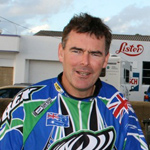
Ed: Hi Warren, and thanks for your time at this late stage in preparations. Can I get a quick run down on who Warren Strange is?
WS: I’m 45, I’ve been married 26 years and I have two boys – 21 and 18. I raced bikes from the age of 9 and haven’t ever really stopped – I’ve always been doing one form or another, but over the last 10 years I have focussed on desert racing. My first riding was done on an ATV70 three wheeler that I wrecked when I ran into the our small town’s school teacher’s car at the end of our driveway. I went on to race a Honda XR75, then a YZ80, then an RM100 and onwards from there. My time is split between Perth and Kalgoorlie. I’m a public company director. My company, Globe Drill, specialises in geothermal drilling for the energy market. I’ve designed, built drill rigs for the past 15 years and operated drill rigs for 15 years before that. Over the past two years I have designed and built a rig that will drill to a depth beyond 4,000m so it’s been keeping me extremely busy. The business was based in Kalgoorlie, but is moving down to Perth progressively.
Ed: You’re family must be very supportive of what you do. Do your boys ride?
WS: They do, but not competitively. My youngest son raced a season in America on the East Coast when he was 15, and my eldest son Brad has done the Gascoigne dash and a couple of off road events. They’ve had a go but they are both focussed on working hard at university right now. My family have been great. My wife has been very supportive. She’s been with me at most events since I was 17 years old, so bike racing has been a part of her life as well as mine and our boys’. Brad is coming along as one of the support crew. I’m also bringing along another chap named Glenn Brown who is a former member of the SAS, so with him and my son I’ll have support with me all the way.
Ed: How have you been preparing for Dakar?
WS: Well, with my very involved business life I don’t get a lot of time to do training so my preparation has just been focussed on myself and my gear. I haven’t done as much ‘riding’ training as I would have liked, but I wasn’t going to learn that much more in a few months after riding for nearly 30 years. In one sense the more I trained on the bike, the more likely I was to injure myself so keeping it to a minimum was fine. I’ve just been working on keeping my weight down and staying healthy. I have a fairly relaxed style of riding which conserves energy but is fairly quick in the bush.
Ed: You mentioned you’ve been mostly doing desert racing. Is that how you came to know GHR Honda?
WS: I started doing the Finke Desert Race and some of the other cross-country events. I’ve been enjoying that style of racing and I can still be competitive in that sort of event at my age. I’ve had some good results in the Finke and some bad runs with mechanical issues on other brands when I was running up the front. But with my lifestyle being what it was I didn’t have a lot of time so I started using GHR for rental packages. I just picked the events that I wanted to do, and the Dakar has been one that I’ve wanted to do for a long time. I just decided hell or high water I was going to do it in 2011. I did the Safari with GHR in ’08 and it was just a fantastic ride, such a good team and was so well organised. When it came down to it I just said to Glenn “I want to do Dakar, you have to do it”.
Ed: For your average rider the Dakar is a pretty daunting proposition. When did you come to that decision?
WS: Probably March or April of 2010. I did think about doing it last year but work commitments got in the way. By March this year I hadn’t ridden for a few months and was feeling pretty miserable. I worked out what was missing – it was racing. I needed to get back on the bike so I called Glenn Hoffmann and said “Glenn, I want to do the Safari and I want to do the Dakar”. He put together a package for rental and support in both events, and I made the commitment. I suppose with Dakar too, because it’s such an expensive event, not a lot of people have the financial capacity to go do it. I guess I’m very lucky that my business has been so successful and has therefore allowed me to do it. That’s the biggest hurdle for most people There are plenty of local riders who would do really well in the Dakar, but they need a lot of extra support to get there.
Ed: What you’re planning to do on your end of year break is quite something. How did you explain it all to you business colleagues?
WS: I said sack me please! (laughs…) I just said like it or not, I am going.
Ed: What are you expecting from the event?
WS: We all have to treat this one as a learning experience. We do have a lot to contend with – the language differences for example. I want to finish in a respectable position. But I want us all to finish. It doesn’t matter how fast you are if you don’t finish. I’m also looking to take a supportive role for Jacob – I won’t hesitate to help him if I can. I’m looking forward to it – this is going to be a great experience for all of us.
Ed: You’ve implied this is not going to be the one and only Dakar you ever do…
WS: No. Definitely not. I’ve come to realise that bikes are a big part of my life and something I have always been involved in. When you have been riding as long as I have it’s pretty hard to give up. To be honest, most who do give it up do so because they don’t have the self discipline to stay in shape. They take the easier route and go racing on 4 wheels. Most would still ride if they had the fitness to do it. I’m pretty strict about how I look after myself. I’ve had a few hurdles along the way though. I had leukaemia and got through it. Keeping in shape is very important, so I know that if I continue to look after myself I’ll be able to keep riding. Something else too – when you meet the people who have been in the game this long, they’re all very level headed people. It’s interesting. There are few ratbags in the racing game, but the people who stick with it are generally good people. We met people racing motocross years ago and they are still really good friends. I’m glad I am part of what’s happening.
Ed: Thanks again for you’re time and I’ll leave you to the rest of your packing.
WS: Bags are already packed. I actually don’t know what to do know other than kill some time until the plane takes off on the 22nd. I do have to do go buy some jocks though!

Rider Profile: Mark Davidson
Dec 20th
 Ed: Mark, thanks for your time to talk to me. Give me a quick run down on who you are and what you do.
I’m Mark Davidson, I’m 51, and I work in the construction industry.
Ed: Glenn tells me that you are self employed. That puts paid to my next question about how you told your boss you wanted time off to go and do a rally over Christmas and New Year.
You mean how do you explain you want a year off?
Ed: So it’s really been in the works for a full 12 months.
MD: Absolutely.
Ed: Glenn told me you’ve been working very hard all year to prepare for the rally. Has it been a hassle to organise the time off to do what you want?
MD: Fortunately not, no. Thankfully I am in a situation where I don’t have to explain that to anybody. My work colleagues and I came to an agreement at the beginning of the year and we signed off on it. It’s worked out well.
Ed: Did you start riding as a kid or were you a late comer to bikes?
MD: I started in trials at about 16 or 17, so I’m not a real go-fast bloke. I think my first bike was a Montesa Cota 123 and then I had a whole bunch of trials bikes so it’s hard to remember which was which!
Ed: At 51 I gather you have a fair bit of riding under your belt…
MD: Well… I do and I don’t. More to the point is when did I STOP riding. I’ve done 6 Safaris… Until 2010 I think my last Safari was in 1996 and basically didn’t get back on the bike until February this year. So it’s a bit of an absence. But I have been pretty fit and and I have always surfed. I’ve never been a couch potato and put on 40 kilos or anything.
Ed: Tell me more about the training you’ve been doing recently.
MD: Time wise, my goal was to do 500 hours on the bike this year. I broke my right wrist riding halfway through the year and I lost 3 months with that injury, but I’ve finished up with probably 320 hours of riding. Basically it’s been 4 days a week – two weekdays and the weekends – continuously apart from the 3 months off with the wrist. I have a training bike which is essentially a replica of the Dakar bike and I’ve clocked up about 170 hours on that. I ride it full of fuel, and I ride it pretty much anywhere – up killer hills, down again and I do plenty of sand. I have a 35km loop in the Stockton dunes that I’d normally ride 4 times in a session. I did the Safari this year. The wrist was a really frustrating thing – a small fracture, but with all the soft tissue damage that comes with it. I’ve tried to focus on my weaknesses, but with a degree of caution – I didn’t want another injury.
Ed: At what stage did you decide you wanted to do the Dakar?
MD: I’d always had it in the back of my mind, but it turns out that the right circumstances arrived to go in 2011. I first met Glenn Hoffmann when he did his first Safari so there’s a fair bit of history with the two of us. I walked in to GHR in early February this year with the intention of asking him to build a bike for me based on my experiences with him on past Safaris, but with no firm ideas beyond that point. Unbeknownst to me he was already in the process of getting a Dakar team up and running. He then said “well actually…” and one thing lead to another. It’s all fallen into place quite conveniently for us both.
Ed: What are you hoping to achieve in the Dakar and what are you expecting from the event?
MD: I hope to finish… nothing more, nothing less. What am I expecting? Pain and anguish I guess (laughs…) and lots of soul searching. I just want to be smooth and keep out of mischief. I think I have a pretty good idea of what I am up for. I’ve done 6 Safaris, and one of those was the 1988 event. That was 10,000km so I know what it’s going to take to spend day after day on the bike. I don’t know about the terrain in detail, but I’ll just take it as it comes and do my best. I’m the tortoise amongst the hares, so I’ll just do my thing. I’m not a complete novice and have my eyes wide open. I don’t think the scenery will be too bad either!
Ed: Are you taking any other support people on the trip?
MD: No. I’ve got the “Cocky Boy”… do I need any more? (laughs…) By the way ask Glenn about the dead bird one day!
Ed: Thanks again for your time Mark.

Mama said there’d be days like this
Dec 17th

Show the nice Doctor our site and where we are off to for Christmas and New Year...
Travel to South American countries does mean there are some infectious disease precautions to consider.
More to the point under “37P3 ADMINISTRATIVE OBLIGATIONS” all competitors and crews must present current and valid vaccination certificates during administrative checks. Numerous visits and best part of a thousand dollars later we are covered for:
Typhoid – Vaccination sometimes recommended 10 days before travel
Hepatitis A – Vaccination recommended 2 weeks before travel
Diphtheria – Vaccination sometimes recommended 3 months before travel
Tuberculosis – Vaccination sometimes recommended 3 months before travel
Hepatitis B – Vaccination sometimes recommended 2 months before travel
Rabies – Vaccination sometimes recommended 1 month before travel
Meningitis (A & C) – Vaccination recommended
Yellow fever – Vaccination sometimes recommended 10 days before travel
Tetanus – Vaccination recommended
Polio – Vaccination recommended

Today... typhoid. Some people enjoy their jobs a little too much.
The Dakar is not for sissies.

Tuesday Chinwag No.17 with Jake Smith
Dec 11th
Transmoto magazine – Tuesday Chinwag No.17 with Jake Smith.

Transmoto magazine caught up with Jake for a quick chat just as the team were packing up the container in November.

Visitors at GHR
Dec 10th
We had a visit from Tony Lockett during the week.
At one stage this year Tony, who had previously ridden with GHR in the 2008 Australian Safari and the ’08, ’09 and ’10 Finke Desert Races amongst other events, was a contender for a start in the 2011 Dakar. However a badly broken wrist in Finke this year meant that he was sidelined with a fairly long recovery. He’s been a frequent visitor to Camp GHR ever since his first ride with us, but this week sampled a taste of what January in South America would have been like when he took Jacob’s development bike for a spin. He came back grinning…

"I want one..." Plugger drops in for a visit


Visitor Comments